Home Dialysis Care
The Freedom to Dialyze on Your Schedule
Home Hemodialysis • Peritoneal Dialysis • Your Way
Learn how ARC Dialysis supports patients who choose to receive treatment in the comfort and convenience of their own home — where program availability applies.
Dialysis on Your Terms
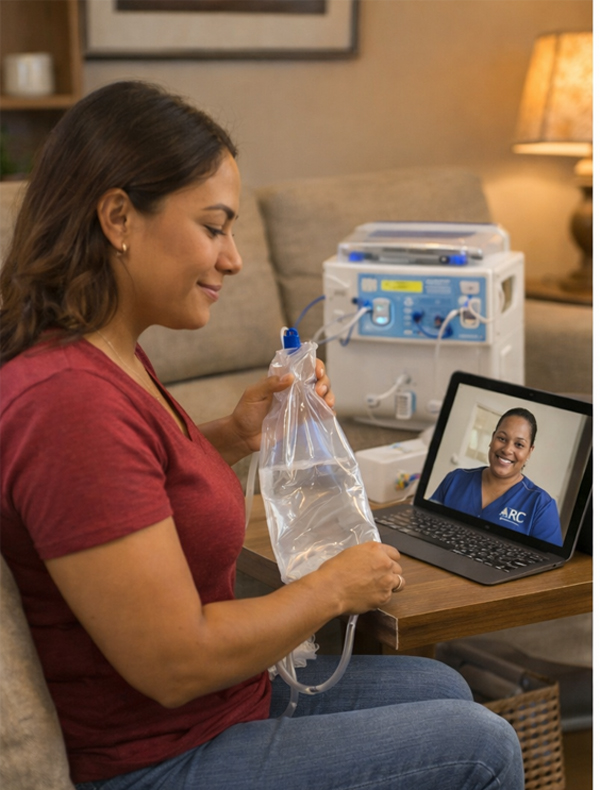
For many dialysis patients, the idea of doing treatment at home — rather than traveling to a center three or more times a week — is appealing. Home dialysis can offer more scheduling flexibility, a sense of independence, and the comfort of familiar surroundings. ARC Dialysis supports home dialysis options including home hemodialysis (HHD) and peritoneal dialysis (PD), where program availability allows. This page will help you understand what home dialysis involves, who may be a good candidate, and how to find out if a home program is available through your ARC center.
What Is Home Dialysis?
Home dialysis means that instead of traveling to a dialysis center for every treatment, patients perform their dialysis at home — either independently or with the help of a trained caregiver. It requires training, equipment, and ongoing clinical support, but for the right patient it can significantly improve quality of life.
Home dialysis is not "easier" than in-center dialysis, but it is different — and for many patients, that difference matters.
Potential Benefits
- Greater scheduling flexibility
- Fewer trips to a dialysis center
- Increased sense of independence and control
- Ability to dialyze while sleeping (for some PD methods)
- Potentially gentler fluid shifts with more frequent dialysis
- More time for work, family, and daily activities
What Is Home Dialysis
Learn more →Types of Home Dialysis
Compare options →FAQs
Get answers →Find a Location
Near you →Types of Home Dialysis
Home Hemodialysis (HHD)
HHD uses the same process as in-center hemodialysis — filtering blood through a machine — but is done at home. Patients typically train for several weeks before performing treatments independently. HHD may be done 4–7 times per week, with shorter session times than the standard 3x per week in-center schedule. Many patients find that more frequent, shorter sessions leave them feeling better overall. A trained caregiver partner is typically required.
Peritoneal Dialysis (PD)
PD uses the lining of your abdomen (the peritoneum) as a natural filter. A catheter is surgically placed in the abdomen, and dialysis fluid is introduced and drained on a regular schedule. PD can be done manually during the day (CAPD) or by a cycler machine at night while you sleep (APD). PD requires no needles and can often be done independently without a partner. It is a gentler option for some patients and may support better preservation of remaining kidney function.
Who May Be a Good Candidate
Not every dialysis patient is a candidate for home dialysis. Factors that typically support home dialysis suitability include physical ability to perform the treatment safely, a suitable home environment, a willingness to train, and — for HHD — a trained care partner. Medical factors such as vascular access, heart function, and existing conditions also play a role.
Your nephrologist will evaluate your specific situation and help you understand whether home dialysis is an appropriate option.
Factors that may support home dialysis:
- Motivated and engaged in own care
- Stable medical condition
- Suitable home environment
- Willing to complete training
- Reliable caregiver (for HHD)
Situations that may require in-center care:
- Complex medical needs requiring close monitoring
- Lack of suitable home environment
- No available trained caregiver for HHD
Training & Ongoing Support
Comprehensive Training Program
Before starting home dialysis, patients and caregivers complete a structured training program. Training covers equipment operation, infection control, emergency procedures, and troubleshooting.
Ongoing Clinical Support
ARC's clinical team remains involved throughout home dialysis. Regular check-ins, lab monitoring, and direct access to clinical staff ensure patients are supported at every stage.
Equipment & Supply Management
ARC helps coordinate the equipment and supplies needed for home dialysis, working with manufacturers and insurance providers to ensure patients have what they need.
Program Availability by Location
ARC Dialysis is committed to expanding access to home dialysis options across its network of Florida centers. If a home program is not yet available at your nearest location, our team can help you explore your options, including whether in-center dialysis or a transfer to a home-program-eligible center may be appropriate.
We encourage all interested patients to ask — availability can change, and we want to connect you with the right resources.
Frequently Asked Questions
Is home dialysis covered by Medicare?
Yes. Medicare covers approved home dialysis modalities including home hemodialysis and peritoneal dialysis. Coverage specifics depend on your Medicare plan and any supplemental insurance. Contact ARC or your insurance provider for details.
Do I need a caregiver to do home dialysis?
For home hemodialysis, a trained care partner is typically required. Peritoneal dialysis can often be done independently. Your care team will discuss requirements based on your specific treatment plan.
How long does home dialysis training take?
Training length varies by modality. PD training typically takes 1–2 weeks. HHD training may take 3–8 weeks depending on the patient and program. ARC's team will guide you through the entire process.
What happens if I have a problem at home during dialysis?
ARC provides clinical support for home patients and can be reached by phone for guidance. In emergencies, patients should always call 911. Your training will include emergency procedures to follow.
Can I switch from home dialysis back to in-center care?
Yes. If home dialysis is no longer working for you, patients can transition back to in-center hemodialysis. Your care team will help manage the transition smoothly.
Interested in Home Dialysis? Let's Talk.
Home dialysis is not right for everyone, but it may be right for you. Contact ARC Dialysis to speak with a care coordinator about whether a home program is available at your location and whether you may be a candidate.
Dialysis Treatment Options
Home Hemodialysis
Filter your blood at home on a flexible schedule. Requires training and a care partner. Availability varies by ARC location.
Peritoneal Dialysis
Use your body's own abdominal lining to filter waste. Can be done manually or overnight by machine. Availability varies by ARC location.
In-Center Hemodialysis
For patients who are not candidates for home dialysis or prefer in-center care, ARC's centers offer comfortable, monitored treatment sessions.
Find a Location Near You
The Kidney Institute of Bonita Springs
26381 S. Tamiami Trail #122Bonita Springs, FL 34134
(239) 388-7770
Questions to Ask About Home Dialysis
"The more you understand about your options, the more confident you'll feel in your dialysis care decisions."
Ask Your Nephrologist
- Am I medically a good candidate for home dialysis?
- Which modality — HHD or PD — would better fit my situation?
- What are the risks and benefits for my specific health condition?
- Is home dialysis available through my ARC center?
Ask the ARC Care Team
- Is a home dialysis program currently available at my nearest ARC location?
- What does the training process involve and how long does it take?
- What support is available after I start home dialysis?
- How do I get started?
"Home dialysis gives our patients something that is hard to put a price on — a sense of control over their own care. For the right patient, it can be genuinely life-changing."— ARC Dialysis Care Team, South Florida